
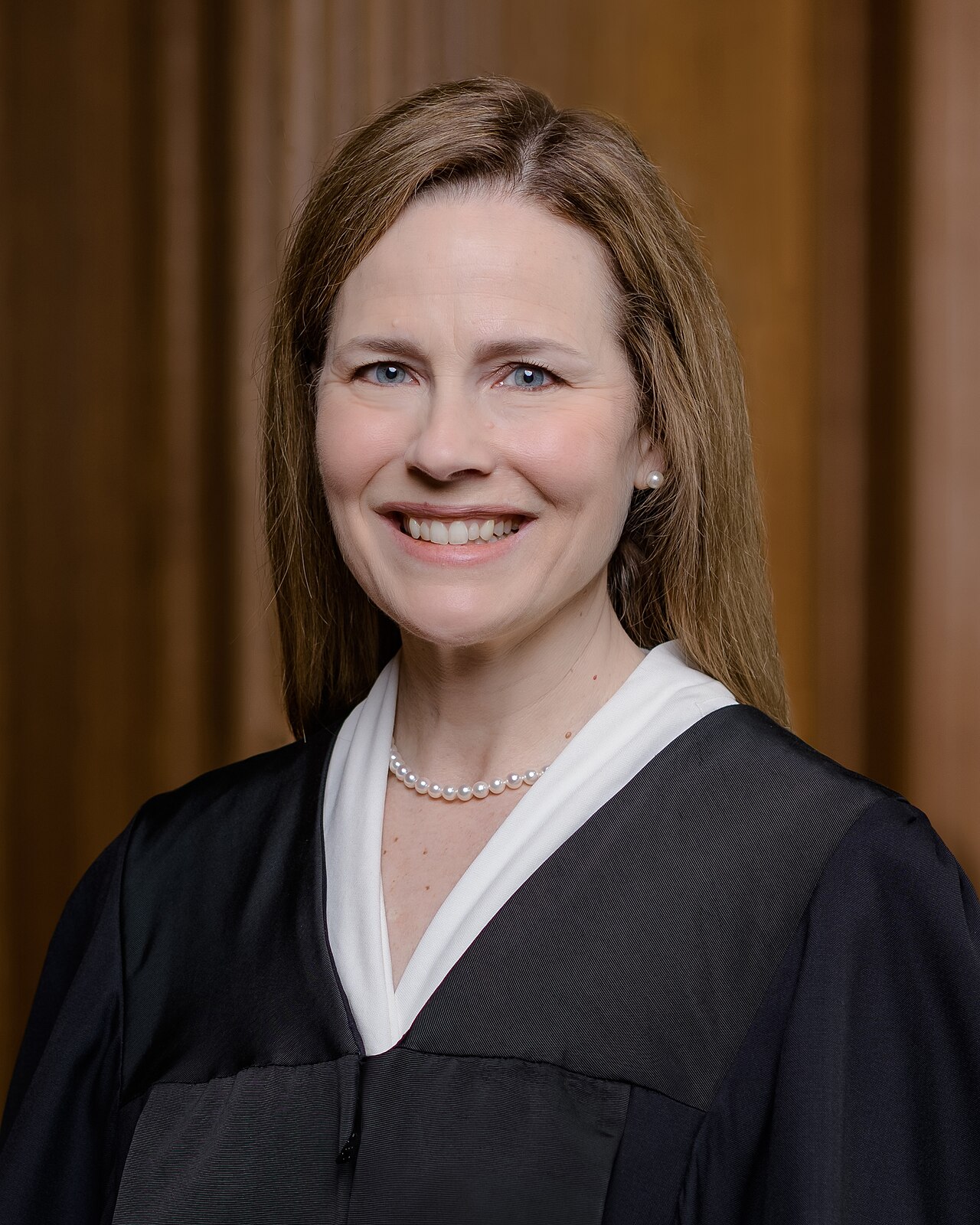
Fred Schilling
· Public domain
Entry openedJan 2025
Last updatedOct 2026
Documented items12
Primary sources11
Page views60
Most Responsible
Amy Coney Barrett
Associate Justice of the Supreme Court, 2020–
Nominated by Donald Trump in his first term and confirmed on October 26, 2020, eight days before the presidential election.
Documented conduct
Jun 30, 2026
Birthright citizenship: the Court divided
Joined the opinion striking the order down. Trump v. Barbara. The Court held that children born in the United States to parents unlawfully or temporarily present are subject to its jurisdiction and are citizens at birth under the Fourteenth Amendment, striking down the executive order of the first day of the term.
Source: Trump v. Barbara, No. 25-365 (June 30, 2026)
Jun 29, 2026
Overruled Humphrey's Executor
Joined the opinion. Trump v. Slaughter, decided six to three. The Court held that the statute protecting Federal Trade Commission members from removal except for cause violates the separation of powers, and overruled Humphrey's Executor v. United States — "If anything more is left of Humphrey's, we overrule it." That 1935 decision had stood for ninety-one years as the basis on which Congress built the independent agencies: bodies whose members a President could not dismiss for disagreeing with them. Their heads are now removable at will. The Federal Reserve was excepted. Justice Sotomayor dissented, joined by Justices Kagan and Jackson.
Source: Trump v. Slaughter, 609 U.S. 422 (2026)
Apr 29, 2026
Narrowed the Voting Rights Act
Joined the opinion. Louisiana v. Callais, decided six to three. The Court held that Louisiana's congressional map, which gave Black voters a second district in which they could elect a candidate of their choice, was an unconstitutional racial gerrymander, because Section 2 of the Voting Rights Act had not required the State to draw it. The Congressional Research Service summarized what changed: Section 2 is now violated "only when the evidence supports a strong inference that the State intentionally drew its districts to afford minority voters less opportunity because of their race" — proof of intent, where effect had been enough. The Act is of 1965. Justice Kagan dissented, joined by Justices Sotomayor and Jackson.
Source: Louisiana v. Callais, 608 U.S. 85 (2026); CRS Legal Sidebar LSB11431
Feb 20, 2026
The tariffs held unauthorized
Joined the parts of the opinion holding the tariffs unauthorized. Learning Resources, Inc. v. Trump. The Court held that the International Emergency Economic Powers Act "does not authorize the President to impose tariffs", and that the power to regulate importation is not the power to tax it.
Source: Learning Resources, Inc. v. Trump, 607 U.S. 229 (2026)
Jul 23, 2025
Allowed the removal of the product safety commissioners
Trump v. Boyle. The Court stayed an order reinstating three members of the Consumer Product Safety Commission removed without cause, treating the question as controlled by Wilcox. Justice Kagan dissented, joined by Justices Sotomayor and Jackson. Justice Kavanaugh concurred, and would have taken the case outright. The order is unsigned and names no majority. With nine Justices sitting and three dissenting, the other six granted it.
Source: Trump v. Boyle, No. 25A11 (July 23, 2025)
Jul 14, 2025
Allowed the mass firing at the Department of Education
McMahon v. New York. The Court stayed an injunction that had reinstated 1,378 employees of the Department of Education, dismissed under a plan to cut the department roughly in half. It gave no reason. Justice Sotomayor dissented over nineteen pages, joined by Justices Kagan and Jackson, writing that the Court had "handed the Executive the power to repeal statutes by firing all those necessary to carry them out". The order is unsigned and names no majority. With nine Justices sitting and three dissenting, the other six granted it.
Source: McMahon v. New York, No. 24A1203 (July 14, 2025)
Jun 27, 2025
Restricted nationwide injunctions
Wrote the opinion of the Court. Trump v. CASA. The Court held that federal courts likely cannot issue universal injunctions, which left the birthright citizenship order enforceable against anyone who had not personally sued. Justice Sotomayor dissented, joined by Justices Kagan and Jackson. The order itself was struck down a year later in Trump v. Barbara.
Source: Trump v. CASA, Inc., 606 U.S. 831 (2025)
Jun 23, 2025
Allowed removals to countries not their own
Department of Homeland Security v. D.V.D. The Court stayed an injunction that had required notice, and a chance to show a fear of torture, before a person could be deported to a third country. Justice Sotomayor dissented, joined by Justices Kagan and Jackson, calling the decision a "gross abuse" of the Court's discretion. The order is unsigned and names no majority. With nine Justices sitting and three dissenting, the other six granted it.
Source: DHS v. D.V.D., No. 24A1153 (June 23, 2025)
May 22, 2025
Allowed the removal of labor board members
Trump v. Wilcox. The Court stayed orders restoring Gwynne Wilcox to the National Labor Relations Board and Cathy Harris to the Merit Systems Protection Board, letting the President dismiss them without cause while the case went on. Justice Kagan dissented, joined by Justices Sotomayor and Jackson. The order is unsigned and names no majority. With nine Justices sitting and three dissenting, the other six granted it.
Source: Trump v. Wilcox, No. 24A966 (May 22, 2025)
Jul 1, 2024
Presidential immunity for official acts
Joined the opinion except as to Part III–C. The Court held that a former President has absolute immunity from criminal prosecution for acts within his exclusive constitutional authority, and at least presumptive immunity for his remaining official acts.
Source: Trump v. United States, 603 U.S. 593 (2024)
Jun 24, 2022
Overruled Roe v. Wade
Joined the opinion. Dobbs v. Jackson Women's Health Organization: "We hold that Roe and Casey must be overruled." A constitutional right recognised for forty-nine years was ended, and the question returned to the States.
Source: Dobbs v. Jackson Women's Health Org., 597 U.S. 215 (2022); confirmation hearing testimony
Oct 13, 2020
What she told the Senate about Roe
Asked at her confirmation hearing why Roe was not among the cases she had called super-precedents, she answered: "Roe is not a super precedent because calls for its overruling have never ceased." She added that this did not mean it should be overruled, and declined to say how she would rule. SHE GAVE NO UNDERTAKING TO UPHOLD IT. Unlike the two Justices confirmed before her, she was not later said to have departed from what she had told the Senate, because what she told the Senate was that she would not say.
Source: Dobbs v. Jackson Women's Health Org., 597 U.S. 215 (2022); confirmation hearing testimony
Receipts
01
609 U.S. ___ (2026), No. 25-365, decided June 30 2026
Our copy
02
609 U.S. 422 (2026), decided June 29 2026
Our copy
03
CRS Legal Sidebar LSB11431, May 14 2026
Our copy
04
608 U.S. 85 (2026), decided April 29 2026
Our copy
05
607 U.S. 229 (2026), decided February 20 2026
Our copy
06
Trump v. Wilcox, 24A966; DHS v. D.V.D., 24A1153; McMahon v. New York, 24A1203; Trump v. Boyle, 25A11
Our copy
07
606 U.S. 831 (2025), decided June 27 2025
Our copy
08
Trump v. United States, 603 U.S. 593 (2024)
Our copy
09
NBC News, June 24 2022
Our copy
10
597 U.S. 215 (2022), decided June 24 2022
Our copy
11
U.S. Senate Roll Call Vote No. 224, 116th Cong., 2d Sess. (Oct 26, 2020)
Our copy